Dana WhitakerGet the Free ChecklistFree Checklist
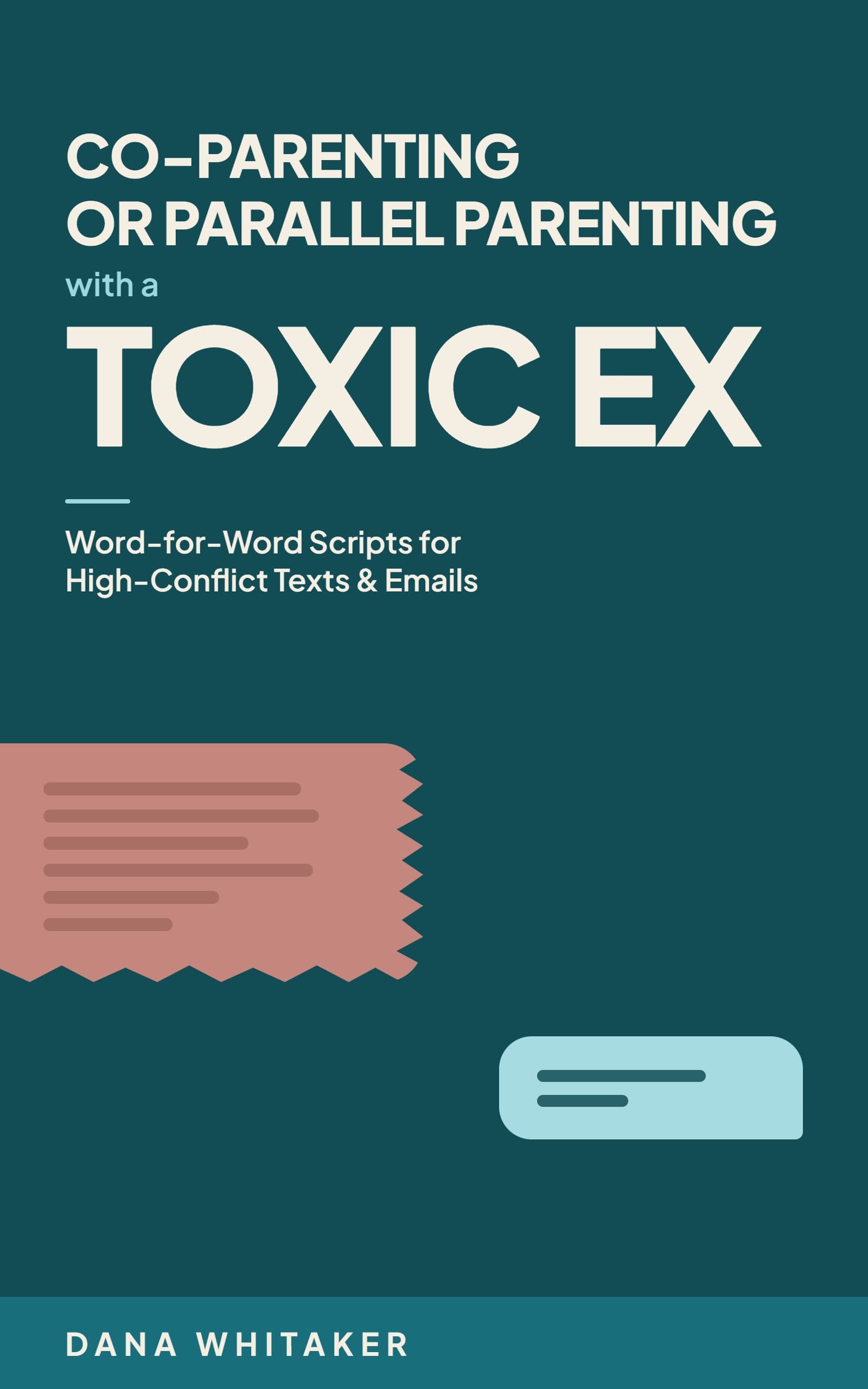
Cover of Co-Parenting or Parallel Parenting with a Toxic Ex by Dana Whitaker
Book 1 · Both Homes Press

Co-Parenting or Parallel Parenting with a Toxic Ex

Word-for-Word Scripts for High-Conflict Texts and Emails: What to Send, What Never to Send, and How to Keep a Clean Record — Even with a Narcissistic Ex

  • Kindle · $9.99
  • Paperback · $16.99

192 pages · 6 × 9 in · Paperback ISBN 978-1-7353931-4-8 · Ebook ISBN 978-1-7353931-5-5

Is this your thread?

Four of the book's 55 scenarios, exactly as they appear inside: the message that lands, and the reply that handles it.

Scenario 1 — The chronic late pickup
The bait

“Running late again, whatever, traffic. Don't make a thing of it. They're fine, aren't they?”

Send this

“Pickup today was 5:40; the time in our agreement is 5:00. I'll keep planning for 5:00. A text when you're running behind helps me plan the kids' evening.”

Scenario 8 — The ambush bill
The bait

“You owe me $212 for the dentist. Pay by Friday or I'm telling my lawyer you're refusing medical costs. Typical.”

Send this

“I received the dental bill for $212. My share per our agreement is $106. I'll transfer it Friday and note the receipt in the log. Please send the itemized invoice when you can.”

Scenario 12 — The holiday split, renegotiated by ambush
The bait

“My parents are flying in for Christmas, so the kids are doing Eve AND morning here this year. You had them last year too. Don't be selfish about this.”

Send this

“Our agreement alternates Christmas Eve and Christmas morning by year. This year Eve is with me and morning is with you, and it flips next year. I know your parents' visit matters — they're welcome to an extra dinner with the kids during your time that week. The split itself stays as agreed.”

Scenario 48 — The 2 a.m. rant
The bait

“Can't sleep on this anymore so you can hear it. You ruined everything and everyone knows it. The dentist thing Thursday is YOUR problem btw since you wanted that dentist. You're welcome. Don't bother replying with your fake calm act.”

Send this — next morning. Nothing that night.

“I saw your messages. On the one schedule item: Thursday's dentist appointment at 4:00 is confirmed, and I'll take Sam. I'm not replying to the rest.”

What's inside

20 chapters, 55 scenarios, four appendices. Built to be used like a fire extinguisher, not read cover to cover.

A Note Before You Begin

  1. Chapter 1 — Why Persuasion Fails
  2. Chapter 2 — The Clean Record Method
  3. Chapter 3 — Channels and Timing
  4. Chapter 4 — When Scripts Are Not Enough

About the Author

Read inside

Chapter 1, as printed. Live text, not an image.

Chapter 1 — Why Persuasion Fails

Your phone buzzes at 10:40 at night. You already know who it is before you look. Nobody else's name tightens your shoulders like that.

The message is about Saturday's pickup, technically. It is three sentences about a time, wrapped in eleven sentences about you — your attitude, your history, your failures as a parent, possibly your failures as a person. It ends with a question that is not really a question. And now you are doing what you always do: composing the reply that finally settles it.

You know the reply. It is thorough. It corrects the record, point by point, with dates. It explains, calmly and completely, why the accusation is unfair. It may reference the agreement. It may reference the last three times. It is airtight. It is also — and this is the hard part — useless. Not because it is wrong. Because of who it is written for, and what it is trying to do.

The letter you keep writing

Almost every parent in a high-conflict co-parenting situation has a version of this letter saved somewhere: in drafts, in a notes app, in their head at 3 a.m. The letter has one job. It tries to persuade.

Persuasion feels like the right tool because in most of life, it is one. With a reasonable person, a clear explanation closes the gap: here is what happened, here is what I need, here is why it is fair. The other person may not love it, but they can follow it, and the matter ends.

High-conflict communication breaks that tool, for a specific reason. Persuasion only works when both people want the matter settled more than they want the exchange itself. When one person gets something out of the exchange — your visible frustration, your long defensive paragraphs, the feeling of having occupied your evening — then a better argument does not end the conversation. It feeds it. Every point you answer becomes a new surface to push against. Your fourteen careful sentences come back as forty careless ones, and the pickup time, the actual subject, is still not settled.

Notice what happened to your evening in the process. The message took ninety seconds to send. Your reply took forty minutes to write, an hour to replay, and a night of sleep to half-recover from. That ratio is the point. In this dynamic, your reaction is not a side effect of the message. Your reaction is the product.

Who it's for — and who it isn't

This book is for

Any parent who shares a child with someone who turns ordinary logistics into a fight.

Parents whose co-parent won't cooperate at all. The scripts depend on your side of the thread, not theirs.

Parents deciding whether to step back to parallel parenting. Part 3 gives you the words for both.

This book is not for

Anyone whose situation is dangerous, not just difficult. Put the scripts down and start with safety and support resources.

Anyone who needs legal advice or help interpreting a custody order. That is a family attorney in your state.

Anyone hoping to change their co-parent. The scripts change the record, not the other person.

Questions buyers ask

Straight answers. If yours isn't here, ask.

No. This book is general information about communication, not legal advice, and it cannot interpret your custody order. Where a script touches a legal question, it says so and points you to the professional who can actually answer it — a family attorney in your state.

About the author

Dana Whitaker

Dana Whitaker writes practical guides for parents navigating high-conflict co-parenting. Her work focuses on one thing: calmer messages, clearer boundaries, and kids kept out of the middle. Through Both Homes Press, she publishes plain-language tools — scripts, checklists, and simple systems — for the conversations divorced and separated parents have every day.

More about Dana →

Also in the series

Book 2 · In productionThe Parallel Parenting PlaybookGet one email when it’s out →

Reader reviews

No reviews yet.

This book is new. When verified reader reviews appear on Amazon, we'll show them here — and nothing else. We don't write, solicit, or curate them.

Read Chapter 1 and decide for yourself ↑
Published by Both Homes PressContent reviewed under our Editorial PolicyLast updated
Free · PDF + Chapter 1

Read Chapter 1 before you buy.

The full first chapter and the Pre-Send Checklist (PDF), free. Then one calm email a week.

One email a week. Unsubscribe anytime. We never share your address.