If You're Not Sure It "Counts": Trusting Your Own Read
The short answer
You do not need to be certain, and you do not need to have a plan. If you are being monitored, isolated, threatened, or controlled through fear, it counts — and it is enough to ask for help. The hotlines below exist for the unsure conversation as much as for the emergency. Many calls to them are exactly that: a person asking a trained stranger whether what they are describing sounds like what it feels like.
The voice that talks you out of it
It usually arrives at a quiet moment, and it sounds reasonable. Other people have it worse. Nothing physical has happened. Maybe it is just a bad divorce. You read a post like when conflict becomes danger and think: close, but not me. You close the tab. You carry on managing it.
This post is for that exact moment, because professionals in this field hear those three sentences from nearly everyone who contacts them — including people in serious danger. Most people who live inside a controlling relationship describe doubt before they describe fear. The doubt is not a verdict on your situation. It is one of the most ordinary parts of being in it.
Why doesn't the comparison work?
Comparison grades your life against somebody else's worst day, and it always finds you wanting — there is always a worse story, and it always seems to disqualify yours. But the worse story is not the measure. What is happening in your home is the measure.
The questions from Chapter 4 measure that directly. Are you afraid of your co-parent — not annoyed, not exhausted, but afraid of what they might do? Do they monitor you, or isolate you, or threaten you, your children, your family, themselves? Has anything physical happened, however "small"? Do the children show fear — of exchanges, of the other home, of saying the wrong thing? If any of those answers is yes, the situation has already answered the question the comparison keeps dodging. You do not need all of them. You do not need the worst one. One is enough to ask.
What changes now
Two small things, neither of which commits you to anything.
Run the questions instead of the comparison. Not once, at 2 a.m., but on paper, in daylight. Write the answers down. A written answer is harder for the reasonable voice to argue with than a feeling you had at midnight — and if you later talk to a professional, it is a clear place to start. The habit is the same one behind documenting threats and stalking: plain facts, dated, in your own words.
Make the unsure call. Not a report, not a decision — a conversation. Tell the person on the line what you have been telling yourself, including the part where you are not sure it counts. That sentence is familiar to them; it may be the most common opening they hear. And tell one person in your own life the whole picture, if you have not. Isolation thrives on partial stories. One person who knows all of it is a safety measure by itself.
What to stop doing
Stop requiring a physical incident before you take it seriously. Coercive control — intimidation, monitoring, isolation, rules enforced by fear — can exist with or without physical violence, and it tends to escalate rather than resolve. Waiting for it to become physical means waiting for it to become worse.
Stop waiting to feel certain. Certainty is not the entry requirement for help; nobody at a hotline will ask you to prove you are sure. If it were required, almost nobody who needs these services would ever qualify — including, the professionals will tell you, the people in the most danger.
And stop treating the call as a commitment. Asking a question sets nothing in motion. You are gathering information from someone trained to give it. What you do with the answer remains yours.
Where the help is
The organizations below are free and confidential, and they are explicitly for the unsure conversation as much as for the emergency. If the phone or computer you are using might be visible to your co-parent, consider a trusted person's device or a library computer instead — the hotline websites also have quick-exit features. Everywhere else, a local domestic abuse service can do what these lines do: listen, help you plan, and connect you with local help.
Free, confidential help:
- United States — National Domestic Violence Hotline: 1-800-799-7233 · thehotline.org
- United States — Crisis Text Line: text HOME to 741741
- United States — 988 Suicide and Crisis Lifeline: call or text 988 — for your own distress, any time
- United Kingdom — Refuge National Domestic Abuse Helpline: 0808 2000 247
- Australia — 1800RESPECT: 1800 737 732
- Canada: sheltersafe.ca — a directory of local shelters and crisis lines across Canada
Why asking works better than wondering
A trained stranger has heard your situation — your actual situation, in your actual words — many times before, and has no stake in grading it kindly or harshly. Their read is information. The doubt you arrived with is a symptom. The book puts it in one line: trust the answer you get more than the doubt you arrived with. Wondering has had months to settle the question and has not. A twenty-minute conversation can.
If your situation looks slightly different
"Nothing physical has happened." Then start at the first question, not the last one: are you afraid of what they might do? Fear, monitoring, and control are the pattern this post is about, and none of them requires an injury to be real — or to be enough.
"I'm not afraid for me. But the children dread the exchanges." The children's fear is one of the questions in its own right, and you are allowed to ask about their situation as well as your own. The safer exchange handoff plan covers the practical side; this call covers the read on it.
"Honestly, the person running out of resources is me." That counts too, and it is in the list above on purpose: the 988 line is for your own distress, any time. Reaching for it is not a detour from protecting your children. It is part of it.
The principle
You do not need a verdict about your life before you make the call. The call is how people get one.
This post follows the closing sections of Chapter 4 of the book, where the full question list and resources appear together.
This post is general information, not legal or therapeutic advice, and it cannot see your whole situation. For advice about yours, talk to a family attorney in your state or one of the organizations above.
Before you send it, run the checklist
Get the printable PDF →PAUSE
- Has at least two hours passed since the message arrived — or a full night, if it arrived hot?
- Have I read it twice, once for the facts and once for the hook?
- Would I send this exact text if I had slept normally and eaten lunch?
TRIM
- Is there exactly one topic in my reply?
- Have I removed every adjective about my co-parent — their tone, their history, their character?
- Have I removed every defense of myself? (Facts I must state stay; justifications go.)
- Does every sentence carry logistics: a date, a time, a place, an amount, or a clear yes/no?
SEND
- Is the reply five sentences or fewer?
- Does it state any agreement in plain words, with dates attached?
- Could this be read aloud to a mediator or a judge, exactly as written, without costing me anything?
- Am I sending it inside my stated hours, in the agreed channel, and nowhere else?
LOG
- Have I entered the date, the topic, and what was agreed into my message log?
- Have I taken a screenshot of anything that may matter later, before the thread moves on?
If any box is empty, the message is not ready. Draft it, leave it, and come back to the checklist. A message that waits an hour almost always sends shorter.
Related posts
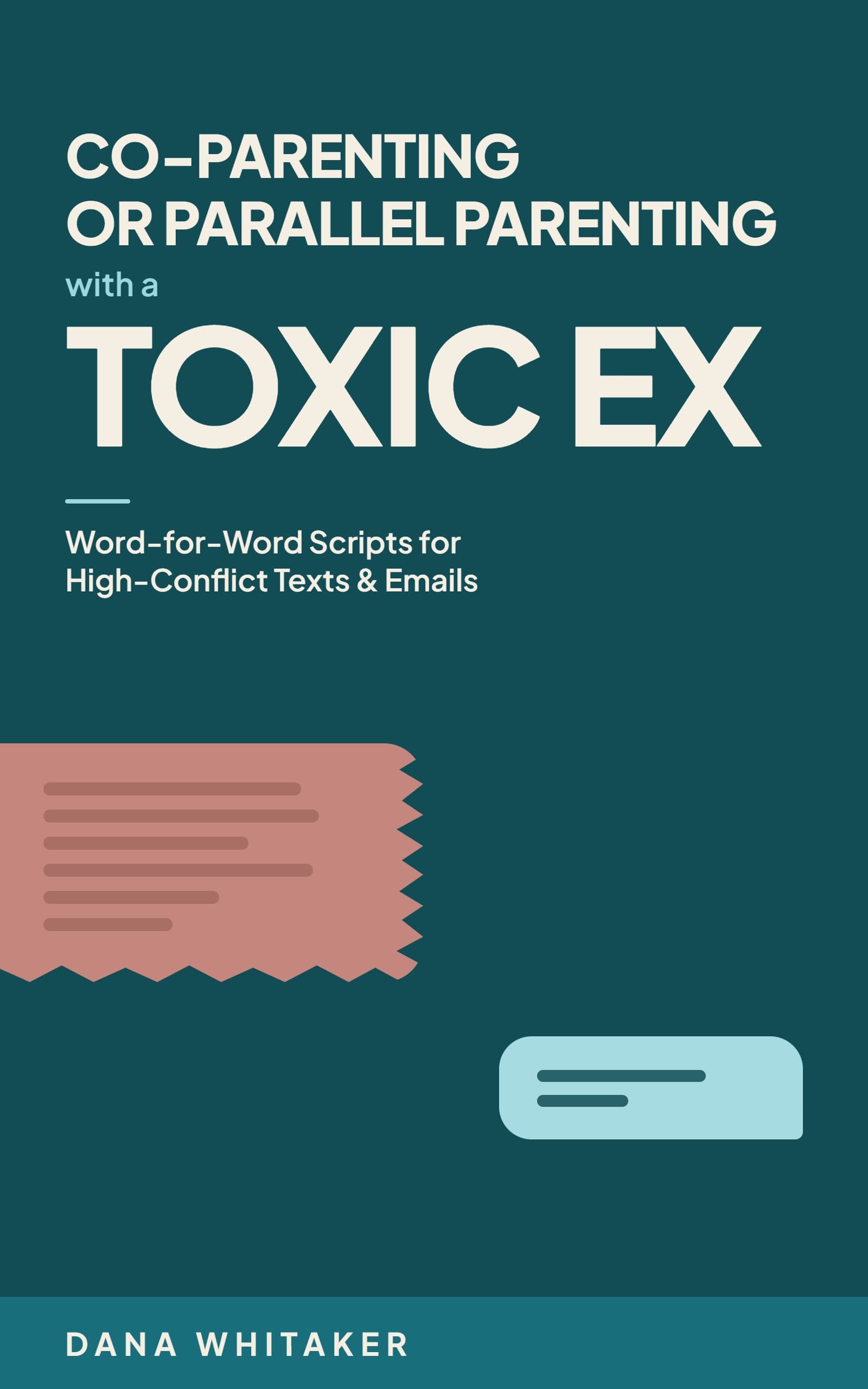
Co-Parenting or Parallel Parenting with a Toxic Ex
55 word-for-word scripts · What never to send — and why it backfires · The 5-sentence rule
Questions readers ask
No. The call is a conversation. Nothing is set in motion by asking a question, and you stay in control of what happens next — including nothing, while you think.
Mostly, they will listen, and ask what has been happening. Many calls are exactly yours: a person asking a trained stranger whether what they are describing sounds like what it feels like. You will not be wasting their time.
Yes — the lines listed here are free and confidential. If the device you are using might be visible to your co-parent, use a trusted person's phone or a library computer to make the call.
This post is general information, not legal or therapeutic advice. For custody questions, consult a family attorney in your state.