When Conflict Becomes Danger: The Line, and What to Do Next
The short answer
Conflict is about logistics. Danger is about control and fear. If your co-parent monitors you, isolates you, threatens you, or frightens you or your children, scripts are the wrong tool for what you are facing. What replaces them is safety planning, documentation kept for protection, and professionals — starting with the organizations listed in this post.
Read this one even if you think it is not about you
Most of this site is about conflict: the baiting message, the broken agreement, the exchange that goes sideways. This post is about something else — the point where the problem stops being communication at all, and where following a script, however calm, is the wrong response.
Read it once, now, while nothing is happening. The patterns below are much easier to recognize at a calm distance than from inside them, and the parents who most need this post are often the last to be sure it applies to them. If parts of it do describe your situation, take the message plainly: this is not a messaging problem anymore, and you do not have to manage it alone.
How do you tell conflict from danger?
Conflict, even high conflict, has a shape you may know well. It flares around logistics — money, schedules, decisions. It is unpleasant, sometimes cruel, and it settles, at least on the surface, between flares. Exchanges happen, the children move between homes, daily life goes on.
Danger looks different, and the difference is not volume. It is control and fear. Ask yourself these questions, honestly:
- Are you afraid of your co-parent — not annoyed, not exhausted, but afraid of what they might do?
- Do they monitor you: demanding to know where you are, checking your phone or accounts, showing up where you are without reason, tracking your movements, or using the children to report on your home and your life?
- Do they isolate you — cutting you off from family, friends, money, transport, or work, or threatening to?
- Have they threatened you, your child, your family, a pet, or themselves, if you do or do not do something?
- Has anything physical happened — hitting, pushing, restraining, blocking a door, driving dangerously with you or the children in the car, or a hand raised in a way that was meant to be understood?
- Do the children show fear — of exchanges, of the other home, of saying the wrong thing — or come home with injuries or stories that do not add up?
Any one of these moves a situation out of the territory of scripts. A pattern of them has a name used by the professionals who work in this area: coercive control — one person using intimidation, monitoring, isolation, and rules enforced by fear to dominate the other. It can exist with or without physical violence. It tends to escalate, not resolve.
What changes now
Three things change, immediately.
Safety planning replaces messaging strategy. The organizations listed below help people build a practical safety plan — around exchanges, around the children's handovers, around your home, your phone, and your documents — tailored to your circumstances, free, and confidential. A family attorney or a local service can tell you what supervised exchange options exist near you.
Documentation changes its job. The message log elsewhere on this site exists to keep communication clean. Documentation for protection is different: it exists so that police, attorneys, and courts can act. How that works, step by step, is in documenting threats and stalking.
Professionals come in now, not later. A family attorney can explain the protective options where you live; many parents find a single consultation enough to learn where they stand, and legal aid organizations exist for those who cannot afford one. Police are the right call for threats, stalking behavior, and any immediate danger — if you or your children are in danger right now, call your local emergency number first and read second.
And one more change, because it is often the hardest: tell someone. A friend, a sibling, a colleague — one person who knows the whole picture. Isolation is not a side effect of coercive control. It is one of its tools, and breaking it, even slightly, is a safety measure in itself.
What to stop doing
Stop answering danger with better messages. Communication techniques designed for arguments do not make coercive control safer — and in some cases a cheerful, organized record-and-respond approach can raise the risk, because control that stops working through messages may look for another route.
Stop deleting the frightening threads. Even the worst messages are part of the record a professional may one day need; keep them, unedited, with their dates.
Stop announcing that you are documenting. The record is not a negotiating tool and it is not a warning. It stays quiet until a professional advises you to use it.
And stop waiting to be sure. If the questions above frightened you, treat that as information, not overreaction. If you're not sure it "counts" is written for exactly that doubt.
Where the help is
Start with a conversation. The hotlines below are staffed by people who do safety planning every day, who will believe you, and who can connect you to local legal and housing help. If using a phone or computer your co-parent can access, consider a trusted person's device or a library computer for these contacts — the hotline websites also have quick-exit features.
Free, confidential help:
- United States — National Domestic Violence Hotline: 1-800-799-7233 · thehotline.org
- United States — Crisis Text Line: text HOME to 741741
- United States — 988 Suicide and Crisis Lifeline: call or text 988 — for your own distress, any time
- United Kingdom — Refuge National Domestic Abuse Helpline: 0808 2000 247
- Australia — 1800RESPECT: 1800 737 732
- Canada: sheltersafe.ca — a directory of local shelters and crisis lines across Canada
Why the shift matters
Naming what you are facing routes you to the right help. Parents trying to message their way out of a control dynamic spend their energy on the one tool that cannot work there, while the tools that can — a safety plan, a protection-grade record, a professional who knows the local options — sit unused. The habits you may already have from calmer chapters, keeping records and writing things down, will serve you here too. But the goal changes. It is not a cleaner thread anymore.
If your situation looks slightly different
Nothing physical has happened. That does not settle it. Coercive control is a pattern of intimidation, monitoring, isolation, and fear, and it exists with or without physical violence. The questions in this post are the measure — not the presence or absence of an injury.
Your fear centers on the exchanges. That is common: a fixed time, a fixed place, the two of you face to face. Exchanges get their own plan — public places, third-party handovers, supervised centers — set out in the safer exchange handoff plan.
Your worry is mainly the children. Danger to children outranks everything else in this post. Threats against a child, physical harm, neglect of basic needs, a child witnessing violence, or a child being used to monitor or frighten you: contact your local child protection service or the police. You do not need proof sorted and organized before you call. Reporting a genuine concern, in good faith, is the correct move even when you are unsure — assessing the concern is their job, not yours.
The principle
The goal is not a cleaner thread. It is a safer life, for you and for your children — and getting help toward it is not a failure of coping. It is the strongest move available to you.
This post is drawn from Chapter 4 of the book — the chapter to read first if any of this sounded familiar.
This post is general information, not legal or therapeutic advice, and it cannot see your whole situation. For advice about yours, talk to a family attorney in your state or one of the organizations above.
Before you send it, run the checklist
Get the printable PDF →PAUSE
- Has at least two hours passed since the message arrived — or a full night, if it arrived hot?
- Have I read it twice, once for the facts and once for the hook?
- Would I send this exact text if I had slept normally and eaten lunch?
TRIM
- Is there exactly one topic in my reply?
- Have I removed every adjective about my co-parent — their tone, their history, their character?
- Have I removed every defense of myself? (Facts I must state stay; justifications go.)
- Does every sentence carry logistics: a date, a time, a place, an amount, or a clear yes/no?
SEND
- Is the reply five sentences or fewer?
- Does it state any agreement in plain words, with dates attached?
- Could this be read aloud to a mediator or a judge, exactly as written, without costing me anything?
- Am I sending it inside my stated hours, in the agreed channel, and nowhere else?
LOG
- Have I entered the date, the topic, and what was agreed into my message log?
- Have I taken a screenshot of anything that may matter later, before the thread moves on?
If any box is empty, the message is not ready. Draft it, leave it, and come back to the checklist. A message that waits an hour almost always sends shorter.
Related posts
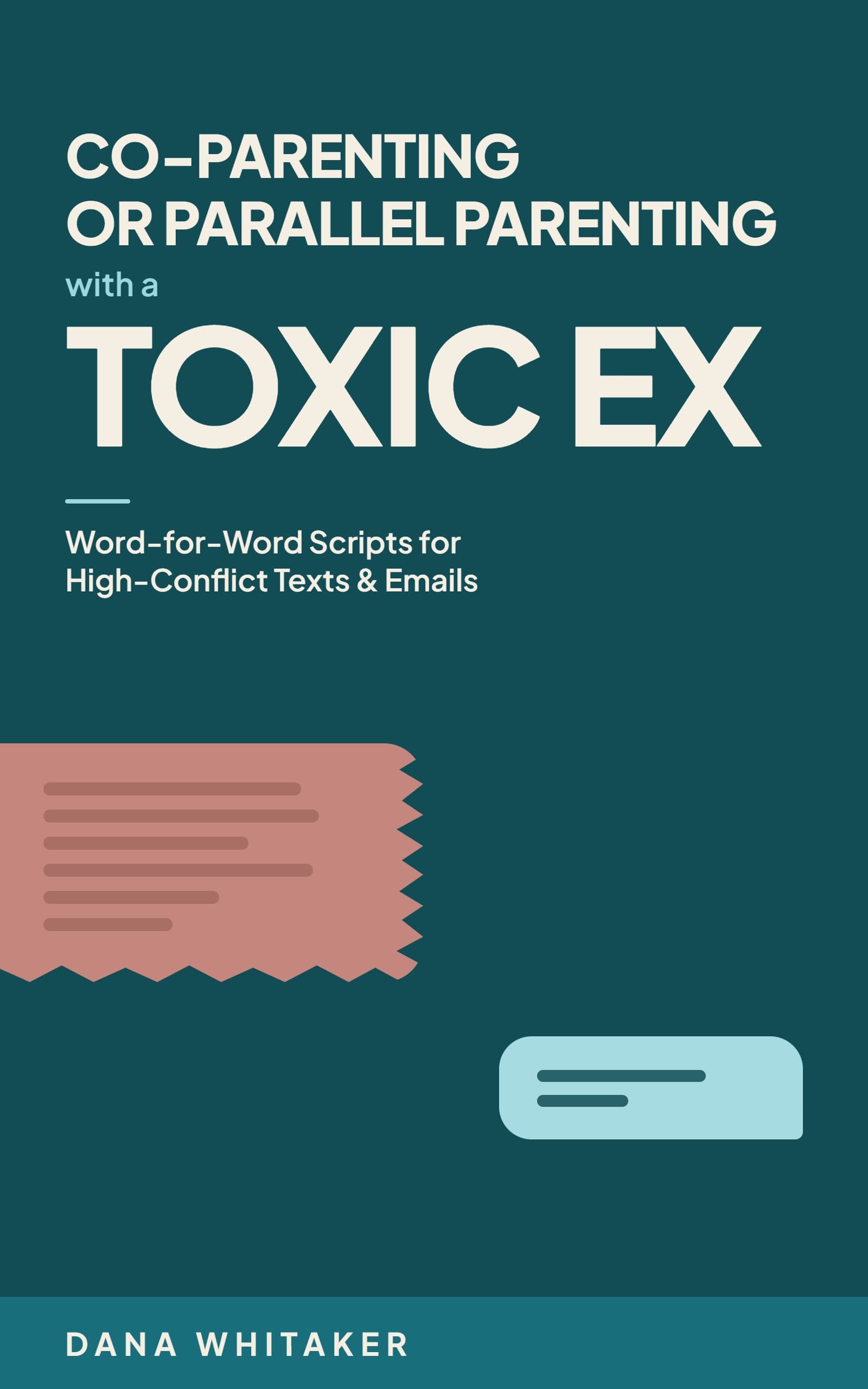
Co-Parenting or Parallel Parenting with a Toxic Ex
55 word-for-word scripts · What never to send — and why it backfires · The 5-sentence rule
Questions readers ask
It can. Coercive control is defined by the pattern — intimidation, monitoring, isolation, rules enforced by fear — and it exists with or without physical violence. Run the questions in this post and trust them more than the absence of an incident.
In a control dynamic, possibly. The scripts on this site are built for arguments, and arguments are not what this is. When control stops working through messages, it may look for another route — which is why safety planning comes before any communication strategy here.
A hotline, for the safety-planning conversation — it is free, confidential, and built for people in exactly your position. Then a family attorney for your legal options where you live; legal aid organizations can help if cost is a barrier. If danger ever becomes immediate, emergency services come before both.
This post is general information, not legal or therapeutic advice. For custody questions, consult a family attorney in your state.