The Relative Sent as a Messenger: How to Close the Triangle
The short answer
When your co-parent routes pressure to you through a relative — an aunt, a former in-law, a cousin "just passing this on" — answer only the underlying logistics, in the normal channel, to your co-parent: "This weekend follows the schedule in our agreement, and the kids will be ready at 5:00 on Friday. If my aunt has a question about a family event, I'm glad to hear from her directly about dates." Do not attack the relative, do not defend your whole case for carrying back, and do not recruit a relative of your own. A triangle needs three points to hold its shape. Remove yours.
The situation
The message does not always come from your co-parent. Sometimes it arrives wearing your aunt's concern, your former in-law's worry, a cousin's "just passing this on." The relative may mean well. The effect is the same: a third person is now carrying pressure into your week.
It works because it is hard to answer. Reply angrily and you have attacked your own aunt — a story that retells beautifully. Defend yourself in detail and your defense gets carried back, edited, as this week's briefing. Say nothing, and the claim sits in the family record unanswered, gathering agreement. The triangle is designed so that every natural move feeds it.
Notice, too, what the version in the book actually contains: not a message from the relative, but a message from your co-parent quoting the relative. The borrowed authority is the point. "Your own family agrees with me" is meant to do what their own arguments cannot.
The bait
Chapter 13, Scenario 40:
"Even your own aunt says you're keeping the kids from me again this weekend. Nice. Your whole family sees what you're doing."
Send this
"This weekend follows the schedule in our agreement, and the kids will be ready at 5:00 on Friday. If my aunt has a question about a family event, I'm glad to hear from her directly about dates."
Read what this reply declines to do. It does not mention the aunt's opinion, your co-parent's claim about your family, or the word "again." It answers the only factual item inside the pressure — this weekend's schedule — confirms it from the agreement, and leaves a door open for the relative to contact you directly about a legitimate family matter. Dates for a family event are a real thing an aunt might need. A verdict on your parenting is not. The reply treats both exactly as they deserve: one gets an open door, the other gets no surface at all.
Running a reply through the free Pre-Send Checklist takes two minutes: danawhitakerbooks.com/free-checklist
Never send this
Never send an attack on the relative, a defense of your whole case for the relative to carry back, or a relative of your own recruited to answer in kind.
The book's why is geometric: a triangle needs three points to hold its shape, and answering the schedule only, in the normal channel, removes yours. An attack on the relative hands your co-parent the best story they will tell all year. A full defense treats the relative as a court courier and guarantees your words travel back mangled. And a counter-relative doubles the network your private life gets discussed in — now two families are relay infrastructure, and the pressure has a return route.
If they escalate
The book's escalation move leaves the thread entirely. Speak to the relative once, briefly, and kindly, in person or by phone rather than in writing. The content is three things: you do not discuss the case; you are glad to talk about family events and the kids' school news; and anything about the schedule goes through the parents. Then stop.
Kindly is load-bearing. This relative may be a person you want at your table for the next thirty years of graduations and weddings. The conversation that protects the boundary without costing the relationship is short, warm, and final — delivered once, not re-argued at every holiday.
Then log the pattern of messages-by-proxy with dates. A pattern of enlisting family is worth more in your log than in any single reply — if this ever reaches a mediator, three dated entries showing pressure routed through relatives say more than your memory of one uncomfortable Sunday.
Why this works
Your record has three readers: your co-parent, you in six months, and any professional who reads the thread cold. In the thread, this exchange shows one parent recruiting family members and one parent answering a schedule question with the agreement and a time. That contrast is the record doing its work without you writing a word of argument. And outside the thread, the same discipline protects something the record cannot: your actual family. The aunt who is told, kindly and once, that schedule matters go through the parents has been given a way to step out of the middle without losing face. Most relatives take it.
Variations
If the relative contacts you directly, in genuine concern — not quoting your co-parent, just worried — use the same three-part conversation from the escalation step, in the same kind order. You are not punishing concern. You are telling a person you value exactly where the door is, and that family news is welcome through it.
If the messenger is your own parent or sibling, recruited by your co-parent — same shape, softer edges, same rule. The conversation happens once, by voice, and the schedule answer still goes to your co-parent in the channel, not home through your family.
If the "relative" is really your child — a message carried by a smaller messenger — that is a different scenario with a gentler script, and it comes first: see when your child comes home carrying messages and when your child reports on the other house.
The principle
You cannot stop people volunteering as messengers. You can refuse to be a point on the triangle. Answer the logistics in the channel, close the route kindly and once, and let the shape collapse for lack of a third point.
The book's full social-and-family chapter — the school gate scene, photos posted against the agreement, and the rest of the public-facing scripts — is in the book.
Before you send it, run the checklist
Get the printable PDF →PAUSE
- Has at least two hours passed since the message arrived — or a full night, if it arrived hot?
- Have I read it twice, once for the facts and once for the hook?
- Would I send this exact text if I had slept normally and eaten lunch?
TRIM
- Is there exactly one topic in my reply?
- Have I removed every adjective about my co-parent — their tone, their history, their character?
- Have I removed every defense of myself? (Facts I must state stay; justifications go.)
- Does every sentence carry logistics: a date, a time, a place, an amount, or a clear yes/no?
SEND
- Is the reply five sentences or fewer?
- Does it state any agreement in plain words, with dates attached?
- Could this be read aloud to a mediator or a judge, exactly as written, without costing me anything?
- Am I sending it inside my stated hours, in the agreed channel, and nowhere else?
LOG
- Have I entered the date, the topic, and what was agreed into my message log?
- Have I taken a screenshot of anything that may matter later, before the thread moves on?
If any box is empty, the message is not ready. Draft it, leave it, and come back to the checklist. A message that waits an hour almost always sends shorter.
Related posts
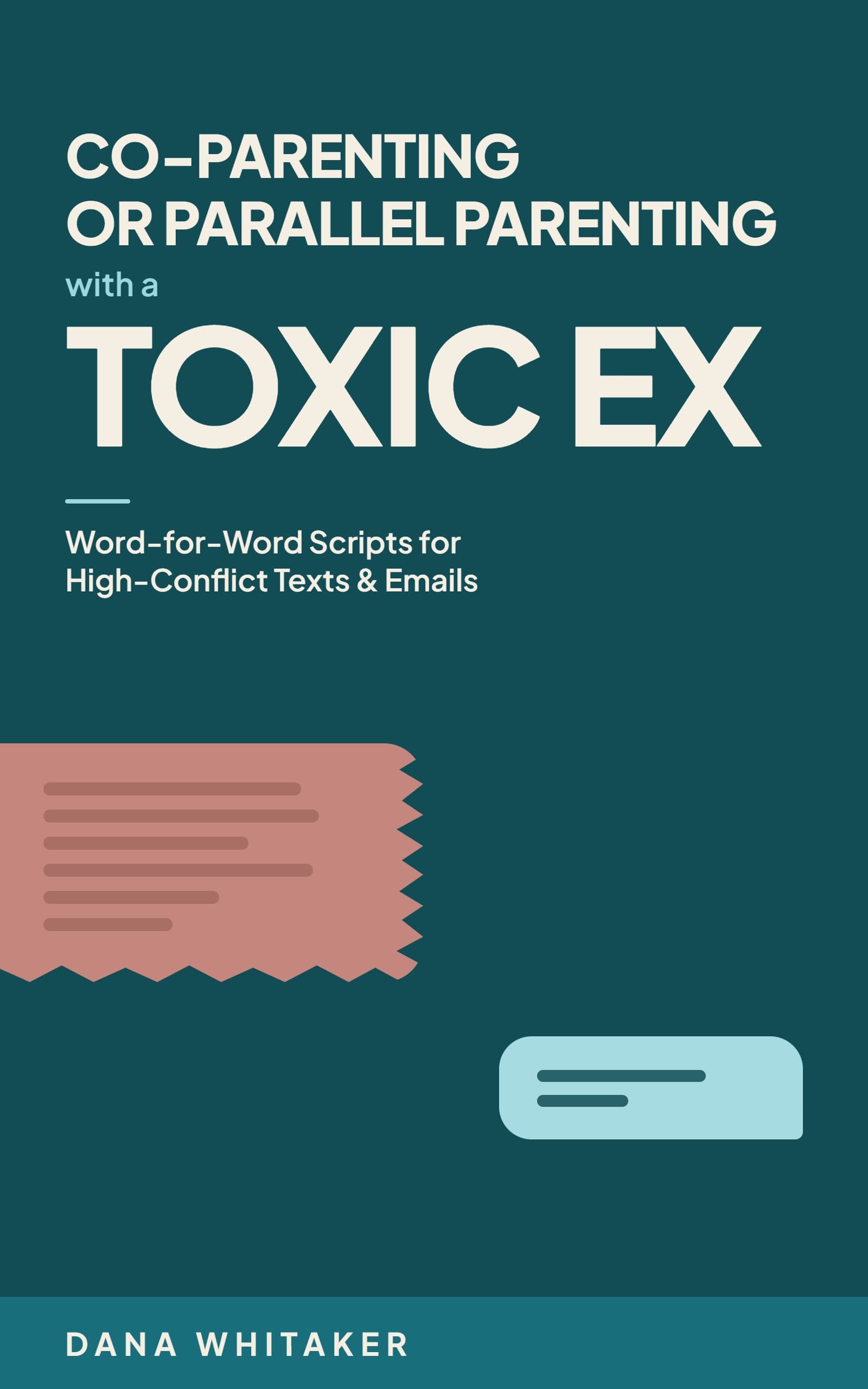
Co-Parenting or Parallel Parenting with a Toxic Ex
55 word-for-word scripts · What never to send — and why it backfires · The 5-sentence rule
Questions readers ask
No. That is the debrief instinct in a new outfit, and it keeps you inside the triangle as its most active point. You already know the only part that concerns you: the schedule. It has been answered.
Stop re-having it. Kindness stays; the conversation does not repeat. Log each relayed message with its date. A relative who continues after a clear, kind request has chosen a role — and your log, not another talk, is the answer to a pattern.
It is the opposite. The refusal protects the relative as much as you: nobody should have to carry two adults' conflict into family events. Glad to talk about the kids' school news and family dates — that is a complete, generous answer.
This post is general information, not legal or therapeutic advice. For custody questions, consult a family attorney in your state.