What Never to Send: 7 Phrases That Blow Up a Co-Parenting Thread
The short answer
The phrases that blow up a thread are rarely insults. They are the reasonable-sounding ones: the full charge sheet capped with "always," the sarcastic sign-off, the forty-message courtroom argument, the defense of your household budget. Each one feels like setting the record straight. Each one actually writes the wrong record — because verdicts are what gets quoted back, and facts are what a clean thread is built from.
Why do these phrases feel so right at 11 p.m.?
Because each one promises the same thing: that this message, finally, will make them see it. The lateness, the silence, the bill with a jab folded into it — the provocations differ, but the reply your thumb wants to type is always some version of the prosecution's closing argument. Thorough. Documented. Unanswerable.
Here is the problem the book returns to in scenario after scenario: a text thread is not a courtroom, and your co-parent is not the judge. The people who may someday read the thread cold — a mediator, a parenting coordinator, a judge — are not scoring who argued better. They are forming a picture of two parents from the shape of the exchange. The seven phrases below all do the same damage to that picture: they make the sender look like the conflict. Each one is drawn from the book's "never send this" lines, with the cost the book attaches to it, and the shape of what those scenarios send instead.
The seven phrases
1. The full charge sheet — every late date since March, capped with "always." The tally feels like evidence. The cost: it invites a counter-tally of your own late days, and the word "always" can be rebutted by a single on-time arrival, produced like an exhibit. Send instead: one factual note about today — the time it happened, the time in the agreement. The worked version is in What to Say When Your Co-Parent Is Always Late for Pickup.
2. The threat to withhold the next exchange. "If you're late again, the kids stay with me next weekend." The cost: this is the most expensive sentence on the list — a withholding threat puts you in breach on paper, in writing, while they were only late. Send instead: the same flat note, plus the pattern in your log, where late pickups accumulate into something a mediator can act on.
3. The sarcastic sign-off — "fine, forget it." The cost: sarcasm in writing is a gift to anyone reading the thread cold later. Stripped of tone, it is the one line that makes you look like the difficult parent — in a thread where you were the reasonable one. Send instead: a complete, final confirming message that states the plan and what silence means — the shape is in What to Text When Your Co-Parent Won't Confirm the Exchange.
4. The clause-by-clause courtroom argument. Forty messages litigating what "alternating weekends" means. The cost: the thread persuades no one — nobody has ever won a contract dispute in a messaging app — and quietly surrendering the weekend mid-argument "to keep the peace" becomes the precedent quoted back at you next month. Send instead: quote the agreement's wording exactly, state the reading you are acting on, act on it, and name the proper venue for the disagreement: the mediator, not the messaging app.
5. Defending yourself against the verdict — the "typical" jab. The bill is real; the "typical" attached to it is bait. The cost: the jab is the hook — defend it and you have accepted that a dentist invoice is a trial of your character. Send instead: answer the amount and ignore the verdict, word for word like this: "I received the dental bill for $212. My share per our agreement is $106. I'll transfer it Friday and note the receipt in the log. Please send the itemized invoice when you can." The jab gets nothing; the invoice request is the record.
6. The line-by-line defense of where the support money goes. The cost: your household budget is not evidence in a text thread, and defending it accepts the premise that you owe an accounting to your co-parent rather than to the order. Support is set by the order, calculated by a formula; none of that can change inside a text about Friday. Send instead: one sentence parking support in its proper channel — then straight back to the pickup time. Every time. The redirect is the strategy.
7. Paying under protest, "for the kids' sake," with a furious paragraph attached. The unapproved $640 laptop arrives; you pay your half so the kids don't suffer, and attach the lecture it deserves. The cost: paying after protesting sets the precedent that buying first works — every future purchase arrives the same way, pre-decided, with you as accounts payable — and the spending review in your paragraph starts the wider war the thread was designed to start. Send instead: decline the reimbursement and name the missing step: advance approval, in writing, before anyone buys.
What if you've already sent one?
Most parents reading this have sent at least three of the seven — probably this month. The record shows patterns, not single evenings, and one frayed message does not undo forty clean ones. The repair is deliberately small: do not send a second message explaining the first, do not apologize in the thread at midnight, and do not escalate to win the exchange back. Log the episode honestly — date, topic, what was said — let the pause rule apply from the next message, and return to the check. The method is not a streak to protect. It is a default to return to. (The full check — Pause, Trim, Send, Log — is in the Five-Sentence Rule.)
Why does cutting them work?
Look at what the seven phrases have in common: every one of them is written for audience one — your co-parent, tonight, in the hope of a reaction. The replies that replace them are written for audiences two and three: you in six months, scrolling a thread you can hand to a stranger without wincing, and the professional reading cold, who will learn everything about both parents from which one of you keeps sending facts. You cannot control which parent your co-parent appears to be in that record. These seven deletions are how you control which one you appear to be.
What if your situation is slightly different?
But the phrase is true — they really are always late. Truth is not the test; function is. An accurate charge sheet still invites the counter-tally and still costs you the evening. The pattern, logged with dates, says "always" far more credibly than the word does.
The message contains a real item I do owe an answer. Then answer the item and drop the phrase. Amounts, times, and dates survive every cut on this list. It is only the packaging — the verdict, the history, the sarcasm — that goes.
My co-parent sends these phrases constantly. That is their record being written, in their words. Your job is narrower and easier: keep your side of the thread in the other genre entirely. Contrast, over months, is the most persuasive document in co-parenting.
The principle
If a sentence would sound perfect read aloud by the other side's attorney, it does not belong in your thread. Facts age well. Verdicts only age.
All seven phrases — and the replies that replace them — come from the 55 scripts in the book, Co-Parenting or Parallel Parenting with a Toxic Ex.
Before you send it, run the checklist
Get the printable PDF →PAUSE
- Has at least two hours passed since the message arrived — or a full night, if it arrived hot?
- Have I read it twice, once for the facts and once for the hook?
- Would I send this exact text if I had slept normally and eaten lunch?
TRIM
- Is there exactly one topic in my reply?
- Have I removed every adjective about my co-parent — their tone, their history, their character?
- Have I removed every defense of myself? (Facts I must state stay; justifications go.)
- Does every sentence carry logistics: a date, a time, a place, an amount, or a clear yes/no?
SEND
- Is the reply five sentences or fewer?
- Does it state any agreement in plain words, with dates attached?
- Could this be read aloud to a mediator or a judge, exactly as written, without costing me anything?
- Am I sending it inside my stated hours, in the agreed channel, and nowhere else?
LOG
- Have I entered the date, the topic, and what was agreed into my message log?
- Have I taken a screenshot of anything that may matter later, before the thread moves on?
If any box is empty, the message is not ready. Draft it, leave it, and come back to the checklist. A message that waits an hour almost always sends shorter.
Related posts
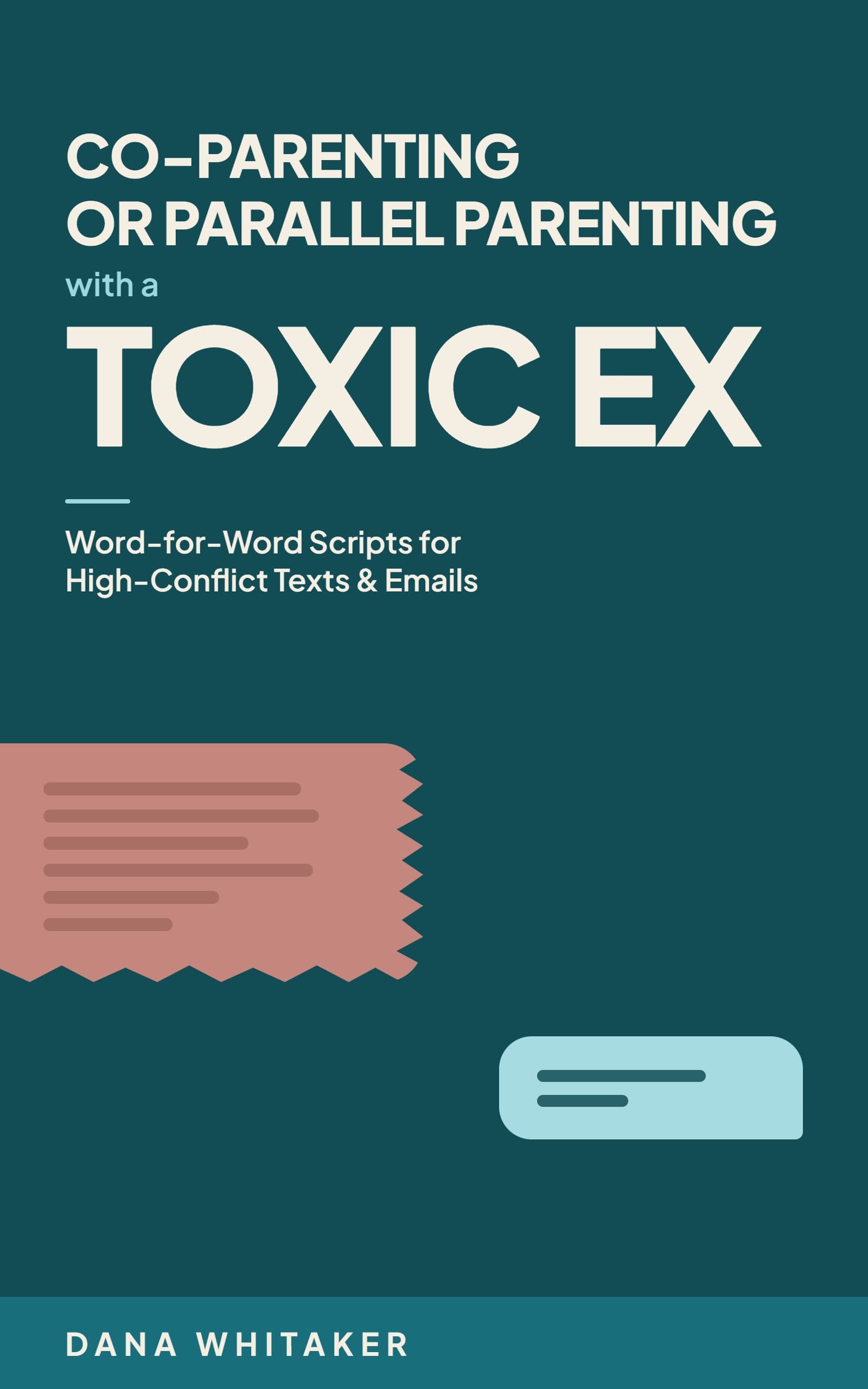
Co-Parenting or Parallel Parenting with a Toxic Ex
55 word-for-word scripts · What never to send — and why it backfires · The 5-sentence rule
Questions readers ask
No. Being the bigger person is a mood; this is a method. Each phrase is cut for a mechanical reason — it invites a counter-tally, writes a breach into your own record, or accepts a premise — and each replacement reply does a specific job: confirm, decline, redirect, or ask for the paperwork.
Standing up for yourself is keeping the agreement, paying exactly what it says on time, naming breaches factually, and taking patterns to a mediator with dates in hand. That is all in the record. What gets cut is only the part that performed strength instead of exercising it.
The same seven. Email feels more formal, which tempts parents to write the courtroom version — pass one of the trim cuts verdicts ("selfish," "typical," "as usual") in any channel. The channel changes; the three audiences don't.
This post is general information, not legal or therapeutic advice. For custody questions, consult a family attorney in your state.