Half Logistics, Half Insult: How to Answer the Message That's Both
The short answer
Read the message once, looking for exactly one thing: the buried logistics item — an appointment, a form, a time. Answer that item only, briefly, the next morning. The insult gets no reply at all: not a defense, not a counter, not even a correction. If there is no logistics item, the correct reply is no reply.
What does a mixed message actually want from you?
It arrives in pieces, the way these always do: four messages, then nine, then a voice note you will not listen to. Old grievances, new accusations, the whole case re-argued to an audience of you, awake, at two in the morning. And buried in the middle, sometimes, is one real item — an appointment, a form, a time.
Most difficult co-parenting messages are built like this, at smaller scale: half logistics, half insult. The insult is not decoration. It is the delivery system. It guarantees that whatever you answer, you will answer emotionally — defending the charge, correcting the history, matching the tone — and the small practical item, the only part that ever needed you, drowns in the exchange. A content-free hostile message has one measurable goal: your engagement. A fast reply teaches that this works at any hour. A long reply teaches that it works well. The mixed message is the same machine with a schedule item hidden inside it, daring you to treat the whole thing as urgent.
So this scenario gets judged by a different metric: not whether you won the exchange, but how little of your day it cost you.
What does the bait look like?
"Can't sleep on this anymore so you can hear it. You ruined everything and everyone knows it. The dentist thing Thursday is YOUR problem btw since you wanted that dentist. You're welcome. Don't bother replying with your fake calm act."
Strip it down and there is exactly one actionable fact in it: a dentist appointment, Thursday, that somebody needs to take a child to. Everything else — the ruined everything, the everyone-knows-it, the pre-emptive strike against your "fake calm act" — is wrapping. Notice the last move especially: it tries to make your calm reply itself a provocation, so that even the correct response feels like losing. It isn't. Keep reading for what the correct response actually is.
What should you send?
Nothing that night. That is the first half of the script, and it is not a technicality. Then, the next morning — if, and only if, a logistics item is buried in the message — answer that item only:
"I saw your messages. On the one schedule item: Thursday's dentist appointment at 4:00 is confirmed, and I'll take Sam. I'm not replying to the rest."
The script is built in three moves. "I saw your messages" closes the question of whether the rant landed — it did, and it changed nothing. The middle answers the one real item completely: the appointment, the day, the time, who is taking the child. Nothing is left dangling that a follow-up could grab. And "I'm not replying to the rest" names the boundary out loud, once, so the silence that follows reads as policy rather than sulk. If there is no logistics item in the message, skip the middle move entirely: the correct reply is no reply, and the message goes in your log, where its volume and timing say everything by themselves.
What should you never send?
Never send this: any answer at 2 a.m., a next-day rebuttal of the accusations, or the rant forwarded to family or friends with commentary.
The 2 a.m. answer is the expensive one, even if its words are perfect — a reply at any point tells the sender that a rant reliably produces engagement, and engagement at 2 a.m. is the premium product. The next-day rebuttal fails more quietly: it accepts the rant's agenda, item by item, and turns one bad night into nine separate arguments. And forwarding the rant recruits an audience you will then have to manage — sympathetic, outraged, and permanently briefed against your co-parent in ways that have a habit of reaching your kids. (The full list of phrases that feel satisfying and cost you is in What Never to Send.)
What if they escalate?
Use the structural tools, not willpower: notifications off overnight, the thread muted, your phone charging in another room — the channel discipline from Chapter 3 of the book. A rant can be true to its name and still not reach you until morning. Then read it once, looking only for a logistics item or a safety issue, and close it. Re-reading at 3 a.m. is not vigilance. It is the rant achieving, slowly, exactly what it was sent to achieve.
Log the date, the time, and the volume, factually. A pattern of overnight barrages is part of the record, and it reads far more damningly in a log — nine messages, 2 a.m., no reply — than in any retelling. One exception stands above every rule in this post: if a message threatens harm to you, your child, or themselves, skip this method entirely and go to the safety material — When Conflict Becomes Danger — and the professionals it points to.
Why does answering only the item work?
Because it reverses the message's economics. The rant was sent to purchase your evening, your sleep, and your defensive paragraphs, at the cost of one thumb and a grievance. The item-only reply refunds almost none of it: the sender gets a four-line administrative answer, in daylight, about a dentist. Over months, that consistency teaches the lesson no argument ever has — logistics gets answers, performance gets a log entry. And for the three audiences who matter, your thread stays immaculate: a professional reading cold sees barrage after barrage on one side and brief, complete, factual replies on the other. You did not create that contrast by winning. You created it by declining. The same discipline, applied to ordinary-length messages, is what the Five-Sentence Rule is for.
What if your situation is slightly different?
The branches below adapt the same script's shape — find the item, answer the item, let the rest sit.
The buried item is money, not a schedule. Same move, different ledger: answer the amount — what it is, what your share is under the agreement, when you will pay it — and ask for the itemized invoice. The verdict attached to the bill gets exactly what the insult here gets: nothing. That case is worked in full in The Ambush Bill.
There is no item at all — it is pure accusation. Then the correct reply is no reply, and that is a complete strategy, not a gap in one. Log the message with its date, time, and volume. Silence after a message with nothing in it is not surrender; the message itself, preserved, is the loudest thing in the file.
The message arrives at a reasonable hour, in ordinary length. The rant is the extreme case; the method scales down unchanged. One paragraph of provocation wrapped around one real question gets the same treatment: the question, answered once, briefly, in daylight — the wrapping, ignored.
The principle
Answer the item. Let the rest sit in the log, where it says everything by itself — and keep your sleep, which was the actual target all along.
This scenario — and the other 54 — is worked in full in the book, Co-Parenting or Parallel Parenting with a Toxic Ex.
Before you send it, run the checklist
Get the printable PDF →PAUSE
- Has at least two hours passed since the message arrived — or a full night, if it arrived hot?
- Have I read it twice, once for the facts and once for the hook?
- Would I send this exact text if I had slept normally and eaten lunch?
TRIM
- Is there exactly one topic in my reply?
- Have I removed every adjective about my co-parent — their tone, their history, their character?
- Have I removed every defense of myself? (Facts I must state stay; justifications go.)
- Does every sentence carry logistics: a date, a time, a place, an amount, or a clear yes/no?
SEND
- Is the reply five sentences or fewer?
- Does it state any agreement in plain words, with dates attached?
- Could this be read aloud to a mediator or a judge, exactly as written, without costing me anything?
- Am I sending it inside my stated hours, in the agreed channel, and nowhere else?
LOG
- Have I entered the date, the topic, and what was agreed into my message log?
- Have I taken a screenshot of anything that may matter later, before the thread moves on?
If any box is empty, the message is not ready. Draft it, leave it, and come back to the checklist. A message that waits an hour almost always sends shorter.
Related posts
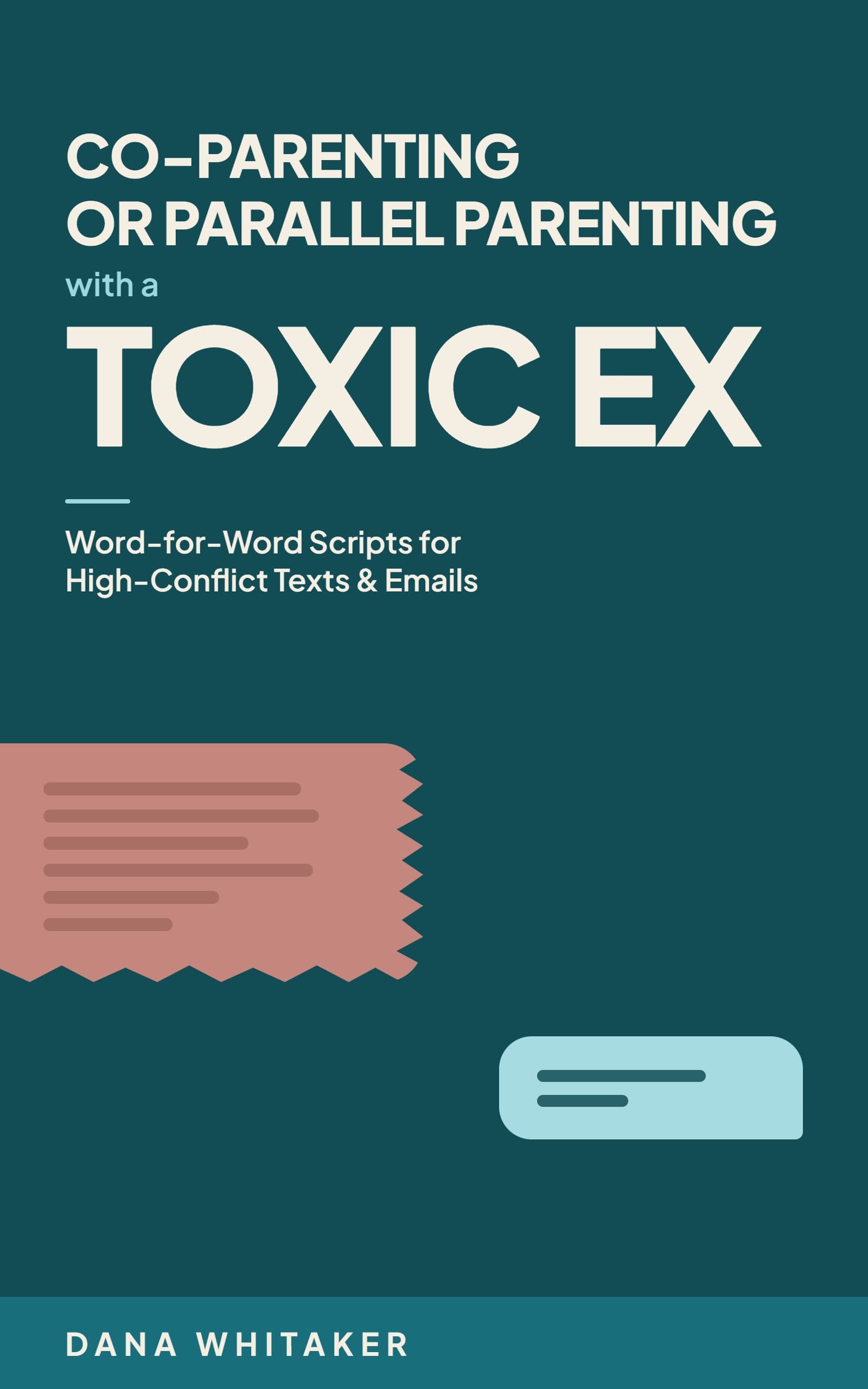
Co-Parenting or Parallel Parenting with a Toxic Ex
55 word-for-word scripts · What never to send — and why it backfires · The 5-sentence rule
Questions readers ask
No — because the reply marks the boundary in words: "I'm not replying to the rest." That sentence is the disagreement, filed permanently. What you are declining is not the position but the format: an accusation answered at length, on their schedule, becomes a debate; an accusation noted and logged becomes evidence.
Save it. Log the date, time, and volume, and keep screenshots in a dated folder outside the messaging app — threads can be deleted and phones get replaced. Deleting feels like closure, but it destroys the one thing the rant can ever be useful for: the pattern, documented.
They may, for a while — judge by the metric this scenario sets: how little of your day each one costs you. Muted thread, phone in another room, one read in the morning, item answered or nothing sent. A barrage that reliably costs you four minutes is a solved problem wearing an unsolved costume.
This post is general information, not legal or therapeutic advice. For custody questions, consult a family attorney in your state.