The Text That Says Nothing: When They Read It and Never Reply
The short answer
When a clear logistics question gets read and never answered, do not send a second, longer version hoping volume will work. Send one message in the book's decision-default shape: state the question, state a fair time to reply by, and state what happens if there is no reply — you proceed on the basis of your agreement. Then proceed exactly that way.
The silence is doing work
You sent a simple question. A form that needs a signature. A time that needs confirming. A cost that needs a yes or no before you can book. You can see it was read. Days pass. Nothing comes back.
Silence like that leaves you in a bad spot either way. Wait, and the deadline moves closer. Chase, and you have sent three messages about one form, each sharper than the last. Act without an answer, and you may hear about it weeks later, as if you never asked.
That stuck feeling is why a default matters more than a reminder. A reminder asks again. A default settles what happens next, in writing, before the deadline arrives. It is the same principle behind what to text when your co-parent won't confirm the exchange: the schedule does not stay open just because a reply does not come.
The bait
In Chapter 15, Scenario 52, the silence breaks only when a routine request finally lands — and the reply punishes you for asking at all:
"WOW. Must be nice. Three weeks of silence and suddenly you need this form signed TODAY. You only ever talk when you want something. Some of us actually parent full-time."
Notice what is not in that message. There is no answer about the form. There is a verdict about the quiet weeks, a verdict about your motives, and a verdict about your parenting. The actual question — a signature by a school deadline — is buried under all three. If you answer the verdicts, the form still does not get signed, and the explosion has done its job: the next time you need to ask something routine, you will hesitate first.
Send this
The book's reply to that explosion is a decision-default message, and it is worth using as the shape for any unanswered logistics question:
"The school form needs both signatures by Friday the 12th — that's the school's deadline, not mine. I've attached it in the app. If I don't hear back by Thursday, I'll send it in with my signature and a note that I sent it to you on the 5th."
This is not presented here as a new script. It is the book's default rule applied in words: state the question, state the deadline that is not yours, state the default if there is no reply, and name the agreement or the documented step you will follow. Chapter 18 gives the standing sentence in the same shape: "If I don't hear by Thursday, I'll go ahead on the basis of our agreement and book for my time."
Why it is built this way: every part can be checked. The date the form was sent is in the thread. The deadline is the school's, not an invented pressure tactic. The default is calm, lawful on its face, and tied to the agreement, not to frustration. And it needs no second message. One reminder at most, on the final day, containing only the deadline and the default — then you do exactly what you said.
Never send this
Never send an apology for the silence, a defense of your parenting, or a burst of frantic over-communicating in the following days to repair things.
The book's why is direct: the silence was not a problem to fix; it was the system working, and apologizing for it teaches that calm periods will be billed to you later. The cost goes further. A defense turns one unsigned form into a trial of your whole record as a parent. Over-communicating after an explosion teaches that an explosion earns attention, follow-ups, and softer terms next time. And a string of chasing messages, read cold months later, makes a simple request look frantic — even though the frantic part was created by the lack of a reply.
If they escalate
Build your arrangements so the cycle cannot hold logistics hostage. That means deadlines with stated defaults — the decision proceeds calmly either way — which is the heart of the communication diet in Chapter 18.
In practice, that looks dull. The agreement governs when there is no reply. Ordinary logistics get a stated window, often 48 hours. Items involving money, bookings, or dates other people depend on get a longer window, often seven days. Decisions wholly inside your own parenting time are not requests at all. If an explosion arrives after you proceed, do not reopen the decision to calm it down. Log the date, the request, the deadline you stated, and what you did.
Why this works
Every message has three audiences: your co-parent, you in six months, and a professional reading the thread cold. A chasing thread is written for the first audience, and it rarely persuades that audience. A default message is written for the other two. It shows a request made on a clear date, a fair window given, and an agreement followed when no answer came. That is a complete story in a few lines.
It also protects your child from the delay. Forms get filed and exchanges happen as scheduled. Silence still feels rude, but it stops being able to stop ordinary life — the same shift that makes co-parenting vs. parallel parenting work in practice.
Variations
If the item is an ordinary logistics question with no outside deadline — adapt the same script's shape and say so in the message: name the item, give a reasonable window such as 48 hours, and state that if you do not hear back, you will follow the schedule in the agreement. Do not invent a new arrangement as the default. The agreement is the default.
If the item involves money or a booking other people depend on — use the same shape with a longer window, often seven days, and state the step you will take on your own time or under the agreement. The longer window is not weakness. It makes the default harder to dispute later.
If they reply only after you have proceeded — do not undo a step that followed the stated default just to end the argument. Acknowledge the late reply in one line, keep the step in place unless your agreement says otherwise, and log both messages. Late outrage is not a timely answer.
The principle
Silence does not create a new arrangement; it activates the existing one. Ask once, state the deadline and the default, and then let the agreement carry the decision. This scenario is one of 55 worked in full in the book.
Before you send it, run the checklist
Get the printable PDF →PAUSE
- Has at least two hours passed since the message arrived — or a full night, if it arrived hot?
- Have I read it twice, once for the facts and once for the hook?
- Would I send this exact text if I had slept normally and eaten lunch?
TRIM
- Is there exactly one topic in my reply?
- Have I removed every adjective about my co-parent — their tone, their history, their character?
- Have I removed every defense of myself? (Facts I must state stay; justifications go.)
- Does every sentence carry logistics: a date, a time, a place, an amount, or a clear yes/no?
SEND
- Is the reply five sentences or fewer?
- Does it state any agreement in plain words, with dates attached?
- Could this be read aloud to a mediator or a judge, exactly as written, without costing me anything?
- Am I sending it inside my stated hours, in the agreed channel, and nowhere else?
LOG
- Have I entered the date, the topic, and what was agreed into my message log?
- Have I taken a screenshot of anything that may matter later, before the thread moves on?
If any box is empty, the message is not ready. Draft it, leave it, and come back to the checklist. A message that waits an hour almost always sends shorter.
Related posts
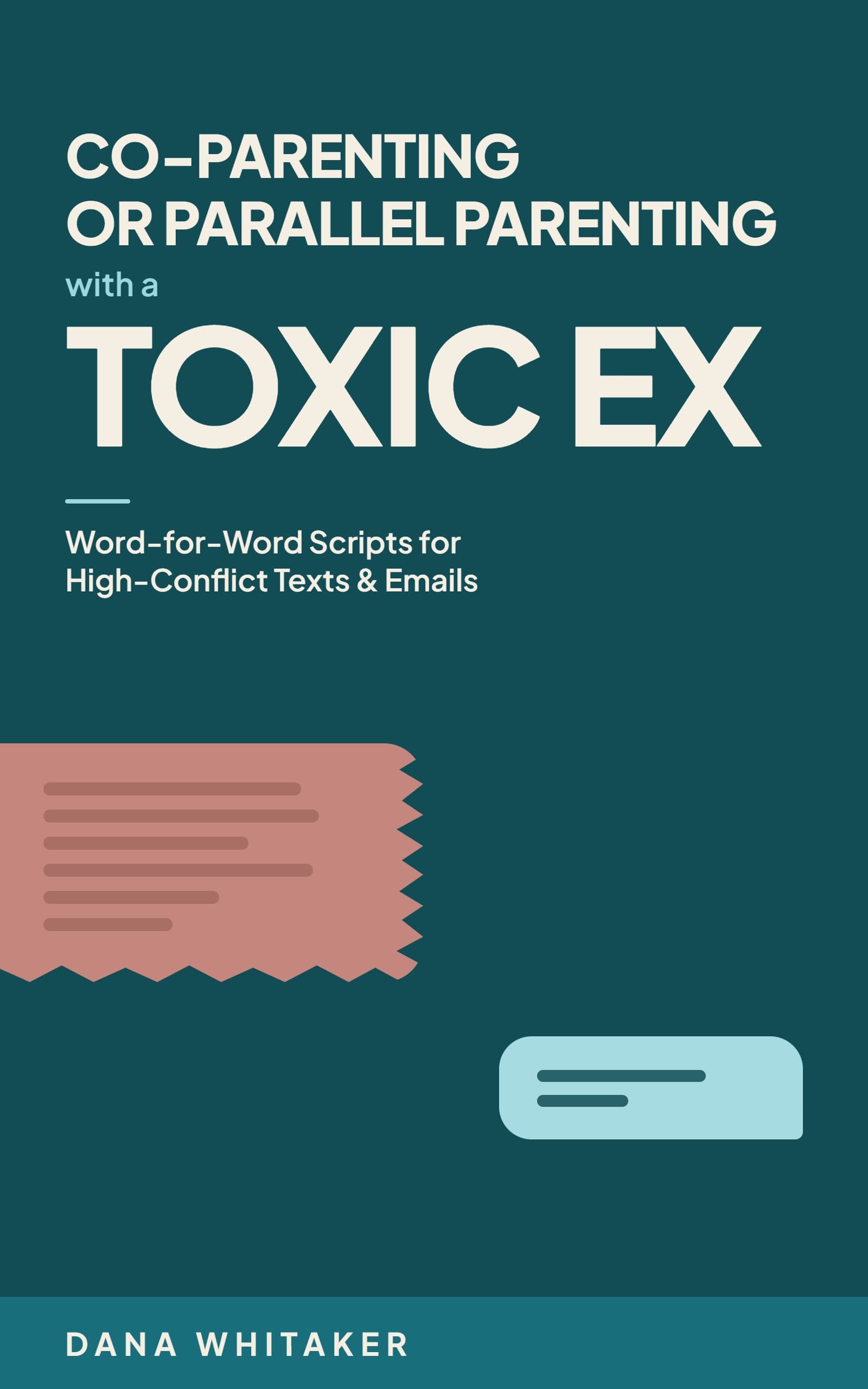
Co-Parenting or Parallel Parenting with a Toxic Ex
55 word-for-word scripts · What never to send — and why it backfires · The 5-sentence rule
Questions readers ask
No. State the window in the first message, send at most one short reminder on the final day with only the deadline and the default, and then proceed as stated. A cascade of reminders trains the silence and frays your record.
Then your default has to be narrower: proceed only with what is inside your own parenting time and your own responsibility, and put larger disputed decisions to a mediator or a family attorney in your state. Do not use a default message to claim authority your agreement does not give you.
Not when the thread shows the full sequence: a clear request, a fair stated window, and action that matches your agreement. That sequence, read cold, is cooperation documented — even when the other side chose not to take part.
This post is general information, not legal or therapeutic advice. For custody questions, consult a family attorney in your state.